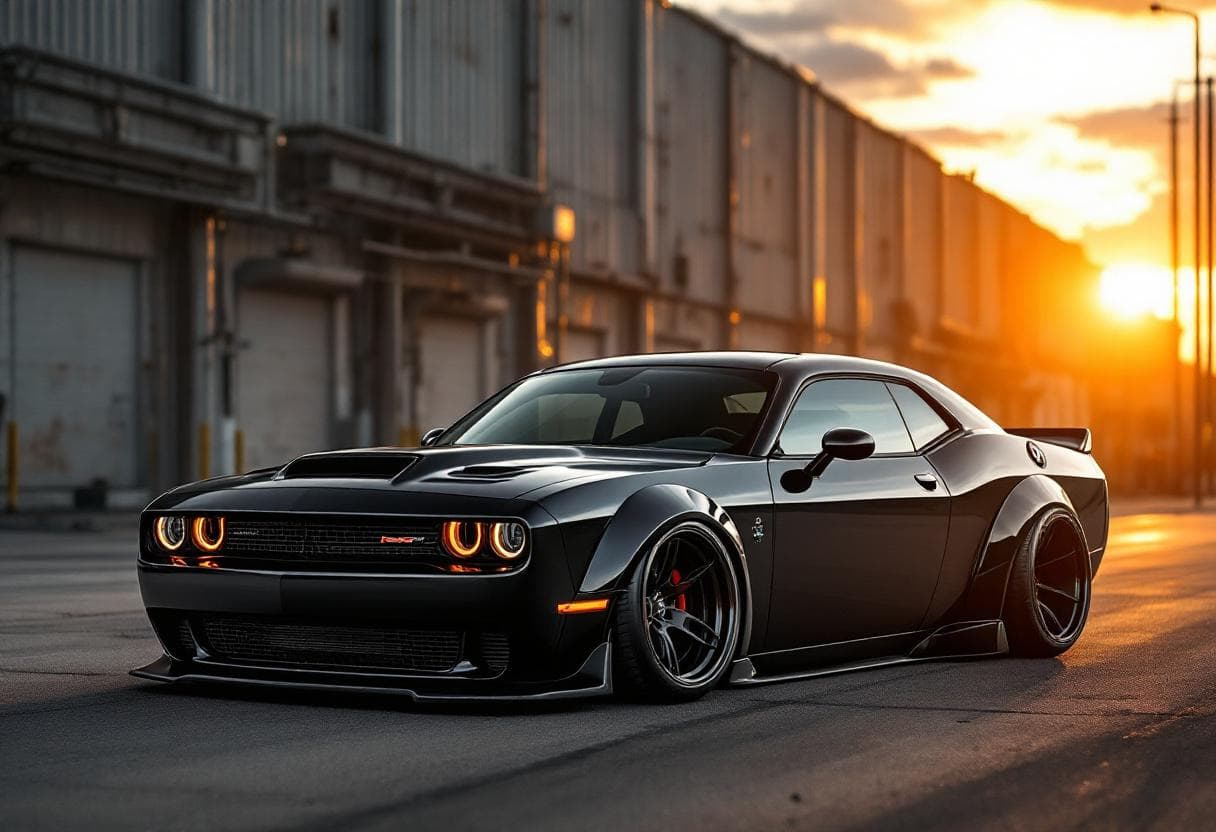
The Dodge Challenger Demon Widebody Kit, Explained
The Demon is the one Challenger you have to think twice about widening, because it came from the factory as a wide-body drag car already. The 2018 SRT Demon was Dodge's single-year assault on the drag strip: 840 horsepower on race fuel, factory drag radials, a transbrake, a wheelie bar available from the parts counter, and enough straight-line violence that the NHRA famously banned it from sanctioned racing for being too fast without a cage. Its bulging fenders exist to cover that drag rubber. So a widebody Demon is not the usual add-width story — it is a question about a modern collector car. The build people actually search for is either exaggerating the aggression the Demon already wears, or restoring a crashed one, or — most often — dreaming, because a real Demon is a $100,000-plus appreciating asset that few owners will cut into.
Real Build Cost for a Challenger Demon Widebody Kit
The honest framing here is different from any other muscle car on the site: the Demon left the factory with the widened bodywork most cars need a kit to get. Its fenders are already flared to clab the wide drag tyres, so 'widebody Demon' in the aftermarket sense usually means one of three things — a further-exaggerated custom conversion (rare, and rarely sensible on a car this valuable), a repair using Demon or Hellcat Widebody panels after damage, or a lesser Challenger being built to look like a Demon. For that last, common path, the Hellcat Widebody fender flares are the real hardware, since the Demon shares the widened body architecture; genuine Mopar flares plus fabrication run several thousand dollars before paint. The mechanical facts are Demon-specific and worth stating: the 6.2-litre supercharged V8, the drag-tuned suspension, the staggered factory wheels on a 5x115 bolt pattern. But the overriding fact is value — a numbers-matching Demon is a car whose worth lives in being untouched, so the sane version of this build is almost always the render, or a tribute built on a cheaper Challenger, rather than a saw taken to a seven-figure-adjacent collector car.
Visualise your Challenger Demon before booking the shop
On a car appreciating past six figures, a widebody Demon is the ultimate case for rendering before cutting — whether you are exaggerating a real one or building a tribute on a lesser Challenger, the picture costs nothing and the mistake costs a collector car. TunedRides renders it in about 30 seconds.
Upload your Challenger Demon photo, free →See Your Challenger Demon With a Widebody Kit in 30 Seconds
- 1Upload a photo of your Challenger Demon. A clear shot in good light is all it needs — side-on is ideal for bodywork modifications like widebody kits. JPG or PNG, up to 10MB.
- 2Select Widebody Kit as your style. Our AI reads your Challenger Demon's body lines and proportions, then applies the transformation accurately. Not a generic edit, a render that respects your specific car.
- 3Download your render. You'll have the result in ~30 seconds. Free is watermarked, Pro ($14/mo or $69/yr) gives 250 HD watermark-free renders monthly — built for sharing with your shop.