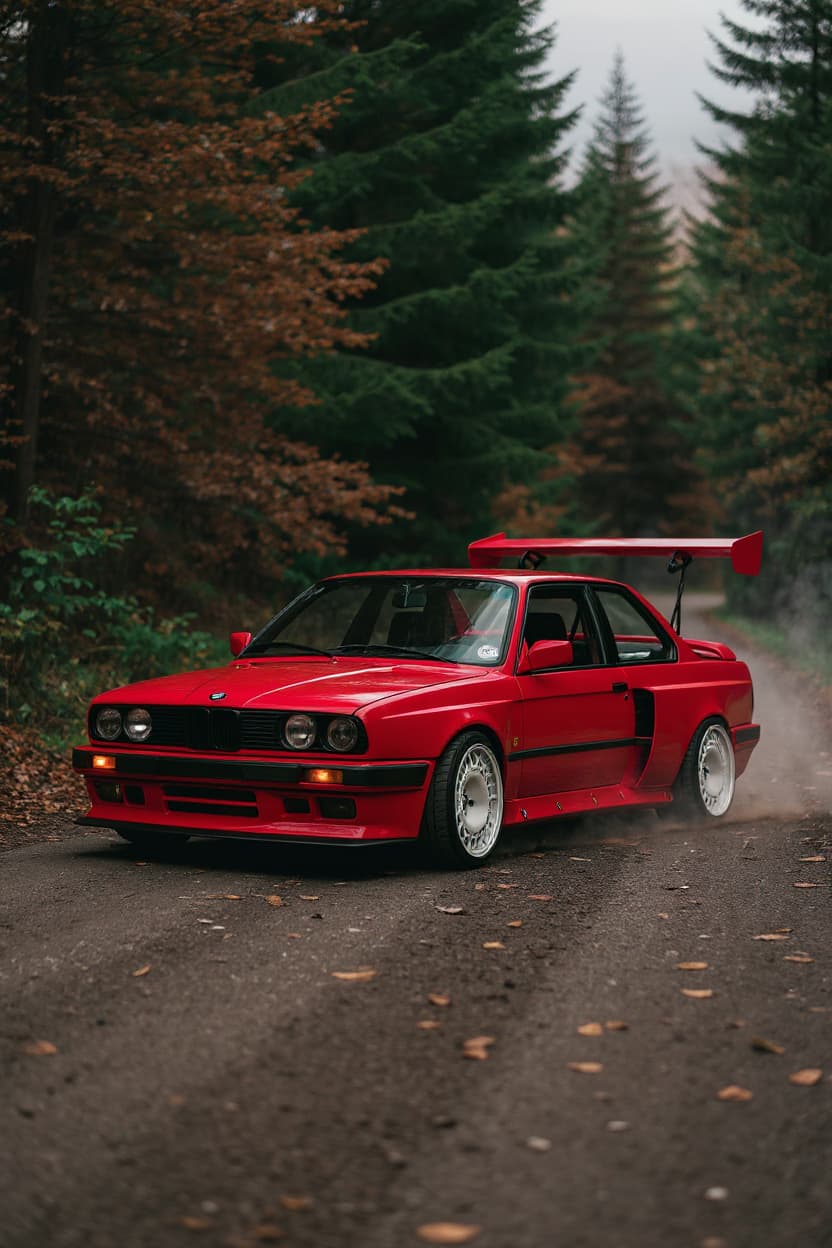
 AI render · Drift
Drift Build Guide: Everything You Need to Set Up a Drift Car
A competition-ready drift build costs $15,000–$40,000. A solid practice car can be put together for $5,000–$8,000. The difference is almost entirely in drivetrain and safety equipment. The chassis, suspension, and differential setup are what make a car actually drift. The aesthetic comes after the mechanicals are right.
Best Chassis Choices for a Drift Build
- Nissan 240SX (S13/S14): the most popular drift platform in North America. Rear-wheel drive, double-wishbone rear suspension, abundant aftermarket support, and plentiful chassis at $3,000–$8,000. The SR20DET swap is the most common engine upgrade. A complete S13 SR20 swap runs $3,000–$5,000 installed.
- Mazda RX-7 (FC/FD): the FD is one of the most visually striking drift builds but expensive. Clean FDs start at $20,000+. The FC is more accessible ($5,000–$12,000). The rotary engine requires specialized knowledge but produces a uniquely rev-happy power delivery. Reliability is the concern for track use.
- Toyota AE86 (Corolla): the iconic touge drift machine. Lightweight, balanced, and culturally revered. Original AE86s are increasingly valuable ($15,000–$40,000 for clean cars). An AE86 with a K-series Honda swap or 4AGE built engine is a capable and lightweight drift platform.
- BMW E36/E46: European drift platforms that have grown in popularity. Good power options with the M50/M52/M54 inline-6, excellent chassis balance, and increasingly available at low cost ($3,000–$6,000 for an E46). Parts are cheap and widely available. The E36 is particularly popular in budget builds.
- Nissan 350Z/370Z: a step up in horsepower and more aggressive chassis. The VQ35/VQ37 engine responds well to modification. The 350Z is the more affordable choice ($8,000–$14,000) and has better drift spec aftermarket. The 370Z is stiffer and faster but costs more.
- Lexus/Toyota IS300/IS200: underrated drift platform. The 1JZ engine is already in the car. One of the most popular drift engines. The Altezza/IS body style ages well. A good IS300 drift build is $8,000–$15,000 all-in.
Engine and Power Requirements
A drift car needs enough power to maintain throttle oversteer. The angle of drift is controlled by throttle input. More power = more angle = more tire consumption. A practice car needs 150–200 wheel horsepower minimum on a lightweight chassis. A competitive car needs 400–600whp.
- SR20DET (Nissan): 200–205 hp stock, 350–450whp on built internals with a large turbo. The most common drift engine swap in North America. Reliable, well-documented, strong aftermarket. A complete S14 SR20 swap is $3,000–$5,000.
- 2JZ-GTE (Toyota Supra): the legendary drift engine. 276hp stock, 500–800whp on built internals. Virtually indestructible with proper maintenance. The 2JZ-GTE swap is expensive ($6,000–$12,000 installed) but the reliability and power ceiling justify the cost for serious builds.
- LS V8 (GM): the American drift answer. A complete LS1/LS2 swap into a 240SX or BMW costs $6,000–$10,000 installed. 400–600whp on a naturally aspirated build, no practical limit with boost. Very popular in Formula Drift.
- 1JZ-GTE (Toyota): similar architecture to the 2JZ but smaller, 250–300hp stock. An excellent mid-power drift engine for builds that need 300–450whp. Already in the IS300, Cressida, and Mark II platforms.
- RB26DETT (Nissan): the Skyline GT-R engine, transplanted into lighter platforms. Expensive ($8,000–$15,000 for engine and swap) but capable of 600+whp on built internals.
See your drift build aesthetic before you start fabricating. TunedRides renders your car in drift style. Free.
Try TunedRides free →
Key Mechanical Modifications
- Limited-slip differential (LSD): absolutely required. An open differential sends power to the wheel with the least resistance. Useless for drift. A mechanical LSD locks both rear wheels together under power. A 2-way LSD locks under both acceleration and deceleration. Preferred for drift. Budget: $400–$1,500 for the unit, $300–$600 for installation.
- Coilovers with high spring rates: drift suspension needs to resist body roll while allowing the car to rotate. Front spring rates of 8–12 kg/mm and rear rates of 6–10 kg/mm are typical for a drift car. Cheap coilovers with inadequate valving will blow out quickly under the lateral loads of drifting.
- Angle kit (steering angle): stock steering lock is typically 35–40 degrees. A drift angle kit increases steering lock to 50–65 degrees, allowing more aggressive entries and maintaining control at higher angles. Essential for competition. Cost: $500–$1,500.
- Drift brake (hydraulic handbrake): a hydraulic handbrake engages the rear brakes independently for initiating drift entries. Required for hairpin-to-tandem transitions in competition. Budget: $200–$600.
- Roll cage: required for any sanctioned competition. A basic bolt-in cage is $400–$800. A fully welded FIA-spec cage is $2,000–$5,000 installed.
- Fire suppression and harness: required by most sanctioned events. A Halon or Novec system is $400–$800 installed. A 5-point harness and seat replace the stock seat and belt.
Budget Drift Build, $5,000–$8,000
A functional practice car drift build for $5,000–$8,000: start with a $2,500 240SX S13 hatch in reasonable condition. Add a used SR20DET swap ($2,500–$3,500 installed), a Cusco or Kaaz 2-way LSD ($600 installed), and BC Racing coilovers ($700 installed). The result is a 220whp drift car on 200mm front tires that will slide consistently and hold up to track days. Not fast. Very capable for learning.
See the drift look for specific platforms at the TunedRides drift build hub. Each car page links to specific drift style renders. See how your car looks sideways before you build it.
Related Drift and Stance Guides
- What is a drift car, how drifting works, what makes a car suitable, and the key differences from a street or track build.
- Best cars for stance and drift, platforms with the right suspension geometry and wheel fitment depth.
Frequently Asked Questions
What is the best car for a drift build?
The Nissan 240SX (S13/S14) is the most popular drift platform in North America, rear-wheel drive, excellent aftermarket, and accessible prices ($3,000–$8,000). For beginners, the 240SX is the right starting point. More advanced builds use the Toyota Supra (2JZ), Nissan 350Z, BMW E36/E46, or Lexus IS300.
How much does a drift car build cost?
A budget practice drift car costs $5,000–$8,000 (chassis + SR20 swap + LSD + coilovers). A mid-range drift build runs $12,000–$20,000 with better engine, full suspension setup, and safety equipment. A Formula Drift-capable competition car costs $30,000–$60,000.
Do you need an LSD to drift?
Yes. An open differential sends power to the wheel with least resistance, making sustained drifts impossible. A limited-slip differential (LSD) locks both rear wheels together under power, allowing throttle-induced oversteer. A 2-way mechanical LSD is the preferred type for drift. It locks under both acceleration and deceleration.
What engine do most drift cars use?
The SR20DET (Nissan) is the most common drift engine in North America. Proven, well-supported, and capable of 350–450whp. The 2JZ-GTE (Toyota) is the benchmark for high-power builds. The LS V8 is popular in American Formula Drift for its combination of power and affordability. The RB26 is used in premium builds.
See your drift build render before you start the build. Free. Upload your car photo or choose a stock model.
Try it free — free →No credit card required. Free tier available.