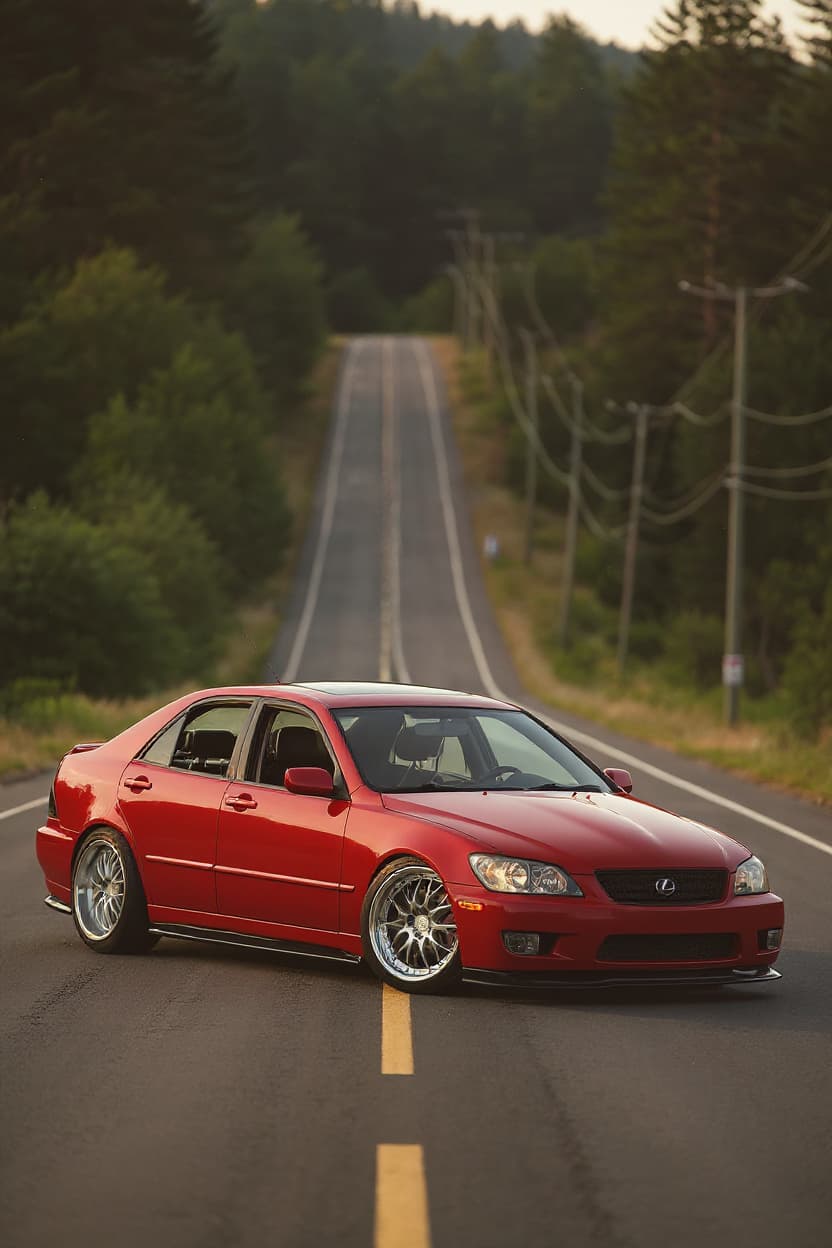
 AI render · Stance
What Is a Stance Car? Everything About Stance Builds Explained
A stance car is a car modified primarily for visual impact, extreme lowering, aggressive wheel fitment, and often negative camber that places the tires at an inward angle. The culture runs from fully functional track setups to show cars that cannot safely drive on public roads. Understanding what stance actually is, and where the line sits between functional and form-only, is the first step in building something coherent.
What Defines a Stance Car
Three elements define a stance build: ride height, wheel fitment, and camber. A stance car sits significantly lower than stock, typically 3–5 inches of drop on a street-driven build, up to 8 inches on a full show car. Wheels are typically pushed to the absolute outer edge of the wheel well, often with an aggressive negative offset that moves the wheel face flush with or slightly outside the fender. Camber, the inward or outward tilt of the wheel, is set negative on most stance builds, meaning the top of the tire leans inward.
The combination of these three elements produces the visual signature of stance: a car that appears planted, wide, and impossibly low. On a well-executed build with proper wheel fitment, the gap between the tire and fender is minimal, sometimes zero, creating what the community calls a 'flush' or 'poke' fitment depending on whether the tire sits inside or outside the fender line.
Types of Stance Builds
- Street stance: a daily-driven or weekend car with moderate drop (2–4 inches), coilovers or air suspension, negative camber of 2–4 degrees in the rear. Drives on public roads without scraping. This is the most practical stance setup and where most builds live.
- Show stance: extreme drop, extreme camber (6–10 degrees negative), often on air suspension to raise the car for transport and lower it for display. Not intended for high-speed driving. Common at car meets and auto shows.
- Static stance: a car that is permanently set at its ride height with no adjustment. Coilovers are set to a fixed position. The car rides this height always. No air bag system. Lower cost than air suspension, less versatile.
- Air suspension stance: the most flexible setup. Air bags at each corner allow the driver to raise the car for speed bumps and driveways, then lower it to the ground for display. Premium setups (AccuAir, Air Lift Performance) allow height memory and smartphone control.
- Functional stance: a track-focused build with moderate negative camber (1–3 degrees) dialed in for cornering performance, coilovers tuned for suspension travel, and wheel fitment chosen for performance. The car looks stanced but is also built to drive hard.
Suspension Setup for Stance
The suspension choice determines whether a stance build is livable. Three options dominate the stance community:
- Coilovers ($600–$2,500): a combined spring and shock unit that replaces the stock suspension. Height is adjusted by turning the lower mount up or down. Most common stance suspension. Brands: KW, BC Racing, Fortune Auto, Öhlins, Bilstein. The quality range is enormous, budget coilovers compromise damping quality and long-term reliability.
- Air suspension ($1,800–$5,000 installed): air bags replace or supplement the spring, with a compressor and management system controlling pressure. Height on demand. Air Lift Performance 3P/3H and AccuAir are the current benchmarks. The system adds complexity and maintenance points versus coilovers.
- Cut springs (not recommended): the cheapest way to lower a car is to cut stock springs, a practice that produces unpredictable handling, rapid shock wear, and potentially dangerous handling characteristics. The stance community widely discourages this approach.
See your stance build before you invest in suspension and wheels. TunedRides renders your car stanced. Free, from your own photo.
Try TunedRides free →
Wheel Fitment for Stance
Wheel fitment is the most technically demanding element of a stance build. The goal is to fill the wheel well as completely as possible without the tire rubbing the fender or inner wheel well. This is determined by three measurements: wheel diameter, wheel width, and offset.
- Offset (ET): the distance from the wheel's centerline to its mounting face. A lower (or negative) offset pushes the wheel outward. Most stock wheels have a high positive offset (ET40–ET50). Stance builds often run ET0 to ET-20. Significantly outboard of stock. Spacers can simulate a lower offset.
- Width: wider wheels fill the arch more aggressively. A stock Civic runs a 6.5-inch-wide wheel; a stance Civic might run 9 or 10 inches wide. Wider wheels require more negative camber to fit inside the fender without rubbing.
- Stretch: running a narrower tire on a wider wheel stretches the sidewall outward, changing the tire's profile and allowing a larger width wheel to fit in a given wheel well. Contested in some circles. Stretched tires have reduced load capacity.
Is Stance Bad for Your Car?
Extreme negative camber accelerates inner tire wear and reduces braking performance because less of the tire contacts the road under straight-line braking. For a show car that drives 2,000 miles per year at low speeds, this is acceptable. For a daily driver, aggressive camber (more than 3–4 degrees negative) creates real operational costs. Tires that wear in 15,000 miles instead of 40,000.
Extreme lowering removes suspension travel, meaning the car bottoms out over bumps that stock suspension would absorb. This is managed on good setups by setting damper rebound correctly. The suspension geometry also changes as the car drops, bump steer, toe change, and handling characteristics all shift. A quality alignment from a shop familiar with stance builds is essential.
Visit the TunedRides stance hub to see stance renders for your specific car. Or try the AI car photo editor to see your car stanced before you modify it.
Frequently Asked Questions
What is a stance car?
A stance car is a car modified primarily for visual impact through extreme lowering, aggressive wheel fitment pushed to the outer edge of the wheel well, and negative camber. The stance community ranges from functional track builds with moderate drop and aligned suspension to show cars with extreme static setups.
Is a stance car safe to drive?
A moderately stanced street build on quality coilovers with 2–4 degrees of negative camber and 2–3 inches of drop is safe to drive on public roads. Extreme show stances, 8+ inches of drop, 8–10 degrees of camber, are not designed for highway driving and carry real safety compromises in braking distance and tire contact.
What suspension is best for stance?
Coilovers are the most popular stance suspension, KW, BC Racing, Fortune Auto, and Öhlins are the most common choices. Air suspension (Air Lift Performance, AccuAir) adds height-on-demand flexibility at higher cost. Avoid cut springs. They produce unpredictable handling and rapid shock wear.
How much does a stance build cost?
A basic street stance build, coilovers, alignment, wheel and tire swap, runs $3,000–$6,000. A full build with air suspension, custom wheels, fender rolling or pulling, and paint work runs $8,000–$15,000. Show-level builds with bodywork modification and premium air management systems can exceed $20,000.
See your car stanced before you spend a dollar. Upload your photo and get a photoreal stance render in 30 seconds. Free.
Try it free — free →No credit card required. Free tier available.