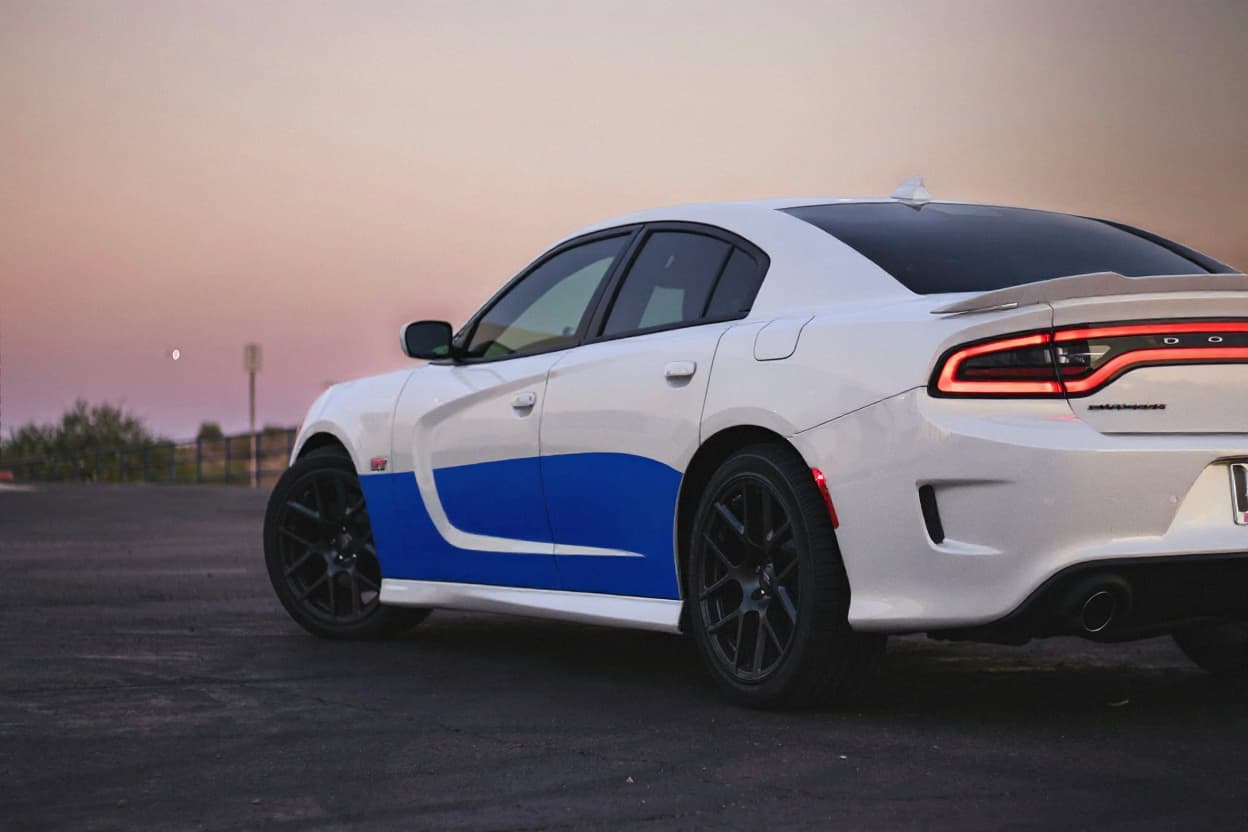
 AI render · Car Wraps
Custom Car Wrap: Design Options, What It Costs, and How the Process Works
The term 'custom car wrap' covers two distinct categories that get conflated constantly. The first is a custom colour change, choosing a non-standard shade, finish, or texture that isn't a stock paint option. The second is a printed graphic wrap, digitally designed artwork printed onto vinyl and applied to the car. Both are 'custom', but they involve different materials, different design processes, and different price structures. Understanding which one you want before talking to installers saves significant time and money.
Custom Colour Change Wraps
A custom colour change wrap means selecting a colour, finish, and film brand that transforms the car's appearance beyond what's available from the factory. This includes matte, satin, metallic, brushed, chrome, colour-shift, and pearl finishes that don't exist as factory paint options on most vehicles. The 'custom' element is the combination of colour and finish, the film itself comes from a manufacturer's standard catalogue.
- Colour options: thousands of combinations across gloss, matte, satin, metallic, brushed, chrome, and colour-shift finishes from brands like 3M 1080, Avery Dennison SWF, KPMF, and Inozetek
- Fully custom mixed colours: some installers work with specialty suppliers to create truly unique shades not in any standard catalogue, these are rare, expensive, and have minimum order quantities
- Partial customs: two-tone wraps (body one colour, roof another), colour-split designs (front half vs. rear half), and accent-panel wraps (hood, spoiler, mirror caps in a contrasting finish)
- Cost for custom colour change: full sedan $2,000–$5,000 installed; SUVs/trucks $3,500–$7,000; partial wraps (hood + roof + mirrors) $600–$1,500
Custom Printed Graphic Wraps
A printed graphic wrap uses wide-format digital printing to apply any artwork, pattern, photograph, or graphic design onto the vinyl before installation. The print is laminated with a clear overlaminate for UV protection and durability, then installed over the vehicle exactly like a standard colour film. The design can cover the entire vehicle or be applied as panels, stripes, or accents over a base colour wrap.
- Full printed wrap, the entire vehicle surface is covered with a custom-printed design. Can replicate any artwork, livery, photograph, or pattern. Used for race liveries, commercial fleet branding, and high-end show cars.
- Partial printed design over colour base, a solid colour film is applied first, then printed graphic panels are applied over specific areas (hood, doors, rear). More affordable than a full print and allows the base colour to show through as a design element.
- Printed accents and decals, specific graphic elements (stripes, numbers, logos, Japanese kanji, anime characters) applied to targeted panels. More cost-effective than a full print for builds where you want graphics in specific areas only.
- Anime and custom artwork wraps, fully bespoke printed designs with original or licensed artwork. Popular for JDM builds, show cars, and brand/influencer vehicles. Require a designer and add design fees to the total cost.
Custom Car Wrap Design Process
For a printed graphic wrap, the design process typically works as follows: the designer receives the vehicle's specifications and creates artwork in vector or high-resolution raster format mapped to a vehicle template. The template must match the specific year/make/model to account for panel seams, curves, and hardware cutouts. Installers either work with in-house designers or with specialist wrap design agencies. The design is proofed digitally (on a 3D vehicle mockup or flat template) before printing. The software those designers work in is covered in the car wrap design software guide.
- Design software: Adobe Illustrator and Photoshop are the industry standard. Specialised wrap design tools like Flexi, SA International, and Onyx handle colour profiling for wide-format printers.
- Vehicle templates: accurate panel templates are available from design resource libraries (e.g. CFS Vehicle Templates, Wrap Lab). Using the wrong template is the most common cause of misaligned designs.
- Design fee: $200–$800 for professional wrap design, depending on complexity. Simple colour blocks and stripes are at the low end; fully bespoke full-vehicle artwork is at the high end.
- Print turnaround: typically 2–5 business days from final artwork approval to printed film ready for installation.
- Revision cycles: most designers include 2–3 rounds of digital revisions before final proof approval. Changes after printing are expensive. Approve digitally carefully.
Custom Car Wrap Cost Breakdown
- Custom colour change, full sedan: $2,000–$4,000 (standard cast film) to $4,000–$8,000 (chrome or specialty film)
- Custom colour change, SUV/truck: $3,500–$6,000 (standard) to $6,000–$12,000 (chrome/specialty)
- Full printed graphic wrap, sedan: $3,500–$7,000 total (film + print + install), depending on design complexity and printer quality
- Full printed graphic wrap, SUV/truck: $5,000–$10,000 total
- Partial printed design (hood + roof over colour base): $1,200–$3,000 depending on artwork complexity and vehicle size
- Printed accents / decal set: $200–$800 installed
- Design fees (if applicable): $200–$800 for professional artwork
- Key cost variables: installer labour rate (varies 20–40% by region), film brand and finish, vehicle size, surface condition (prep adds cost on dented or poorly painted panels)
Custom Car Wrap Ideas by Build Style
- Two-tone roof wrap. The most popular partial custom. Contrasting roof colour (often gloss black, matte white, or carbon fiber) over a solid body colour. Achievable for $300–$600 and dramatically changes the car's profile.
- Racing livery, stripes, numbers, and sponsor graphics referencing motorsport heritage. Le Mans-inspired Gulf livery (blue and orange), Martini racing stripes, and Group B rally colour schemes are consistently popular.
- JDM / anime wrap. Japanese artwork, kanji text, circuit graphics, or anime character panels. Popular on hatchbacks, sports cars, and show builds. Requires either licensed artwork or original commissioned illustration.
- Camo pattern, military or urban camo as a full wrap, either from a standard camo film or as a custom-printed design for non-standard patterns (arctic camo, digital navy, pink camo).
- Gradient / fade, a colour that transitions from one hue to another across the vehicle length or vertically. Requires printed film as standard vinyl doesn't gradient; the colour transition is designed digitally and printed.
- Chrome delete + colour accent, remove all chrome trim with matte black vinyl, add a coloured accent stripe through the body. Clean, modern look that works on almost any vehicle without a full wrap.
- Satin or matte over gloss OEM, applying a satin or matte finish vinyl over factory gloss paint gives the appearance of a custom paint colour at a fraction of the cost and with full reversibility.
Designing a custom wrap and want to see what it looks like on your actual car first? TunedRides AI generates photorealistic renders from your uploaded photo, preview colour changes, patterns, and wrap concepts before talking to an installer.
Try TunedRides free →
How to Choose a Custom Wrap Installer
- Look for 3M MCS, Avery Certified Wrapper, or PDAA (Professional Decal Application Alliance) certification, these programs require demonstrated installation skill and knowledge of film handling
- Ask to see printed wrap work specifically, not just solid colour installs, printing and solid installs are different skill sets; a great colour-change installer may not have printed wrap experience
- Check panel transitions on their portfolio work, seams at door edges, around windows, and at panel breaks show whether the installer has the technique for clean full-vehicle coverage
- Get three quotes for any project over $2,000, labour rates vary significantly and the cheapest bid usually means cut corners on surface prep, which determines longevity
- Confirm they use a commercial-grade wide-format printer (Roland, Mimaki, HP Latex) for printed work, consumer printers produce inferior colour accuracy and UV resistance
Frequently Asked Questions
How much does a custom car wrap cost?
A custom colour change wrap on a sedan costs $2,000–$4,000 installed with standard cast film, or $4,000–$8,000 for chrome or specialty finishes. A fully custom printed graphic wrap on a sedan runs $3,500–$7,000 including design, print, and installation. SUVs and trucks add 30–60% to those figures.
What is the difference between a custom car wrap and a colour change wrap?
A colour change wrap uses standard manufacturer film in a non-factory colour or finish. Matte, satin, chrome, metallic. A custom graphic wrap uses digitally printed artwork on vinyl. Liveries, anime designs, gradients, camo patterns. Both are 'custom' but involve different design processes and cost structures.
How long does a custom car wrap last?
A custom colour change wrap using quality cast film (3M, Avery, KPMF) lasts 5–7 years. A custom printed graphic wrap using laminated print film typically lasts 4–6 years before the print shows UV fade. Both are significantly shorter in high-UV climates without UV sealant protection.
Can I design my own custom car wrap?
Yes, if you can produce print-ready artwork in Adobe Illustrator or Photoshop at the correct vehicle template dimensions. Most installers will print and install from customer-supplied files if the artwork meets their print specs. For complex full-vehicle designs, a professional wrap designer is worth the $200–$800 fee to avoid costly print errors.
Custom car wraps start with knowing what you want. Use TunedRides to visualise colour changes on your actual car before committing to a design consultation.
Try it free — free →No credit card required. Free tier available.