Dodge Challenger wheels
Challenger wheels split along the car's two souls: the drag strip and the boulevard. One crowd buys light rears and skinny fronts to launch; the other buys heritage designs that could have shipped in 1970. Both shop the same 5x115 Mopar platform — and both benefit from a fact most muscle cars can't claim about the widebody era. Preview any set on your actual Challenger first, free.
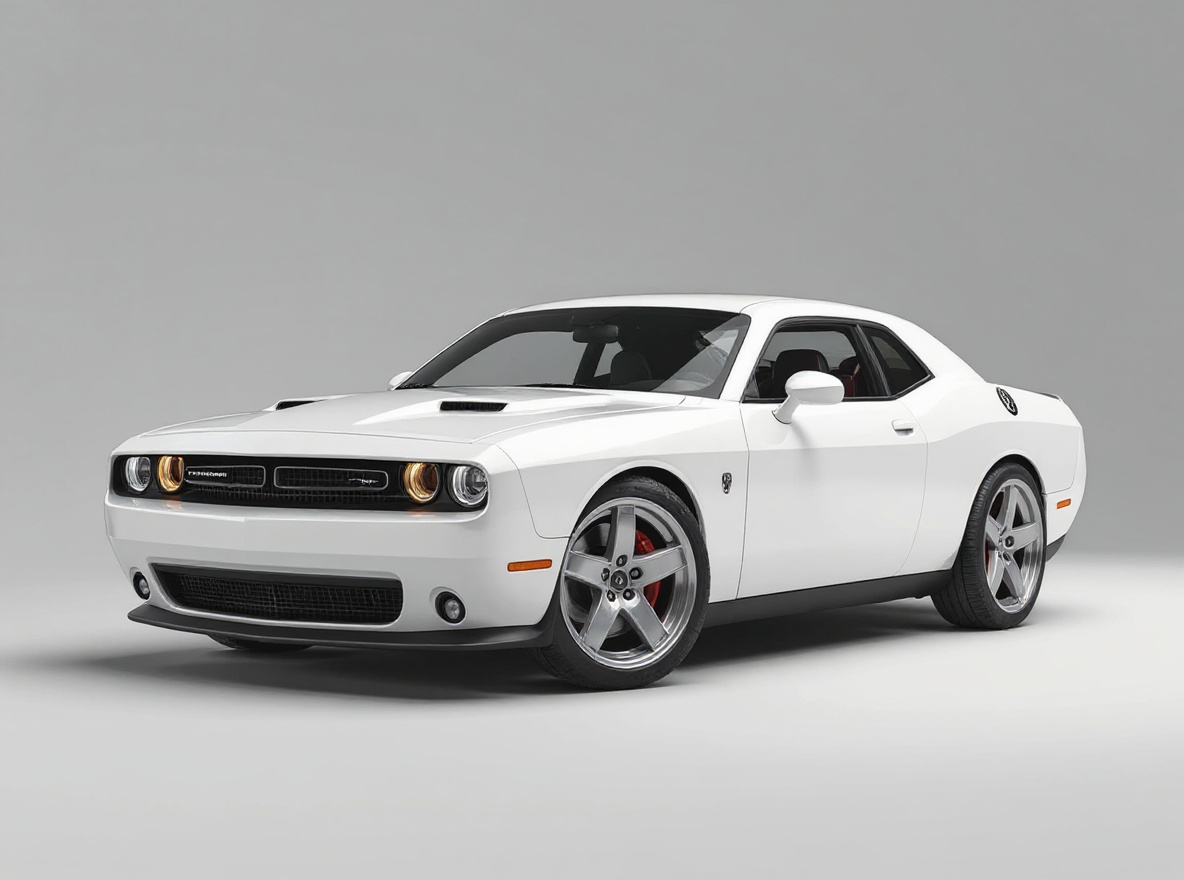
Popular wheel styles for the Dodge Challenger
Anything from restrained OEM-plus to an aggressive stretch — tap a style to render it on your Challenger in the tool.
Finishes to try
Wheels on the Dodge Challenger: what actually works
The Challenger's most interesting wheel fact hides in its fastest trims: the Hellcat Widebody and its siblings run a square fitment from the factory — the same 20x11 wheel at all four corners — bucking the staggered muscle-car orthodoxy. Dodge did it for grip balance, and it quietly makes the widebody cars the easiest big-power muscle cars to buy wheels for: one size, rotatable tyres, no front-versus-rear catalogue dance. Around that anchor, the scene splits by intent. The drag side runs the strip uniform — light wide rears, skinnies up front — on a car whose Demon trim shipped from the factory on drag radials. The street side leans heritage: modern re-issues of classic Mopar designs, from steel-look wheels to period five-spokes, suit the Challenger's retro body like no other modern car.
Buying wheels for a Challenger: the traps and the smart path
Start with the platform truth shared across Mopar's LX family: 5x115, commonly confused with the Japanese 5x114.3 that will seat but never centre — buy only wheels specified for the platform. Then let the trim guide the layout: widebody cars are square from the factory and are best kept that way; narrow-body cars take the classic staggered look happily. Drag builds are their own economy — a dedicated strip set with light rears transforms launch on a car this heavy, and the used market for Challenger drag sets is mature. Heritage builds reward restraint: the retro designs work because the body is genuinely retro, and modern oversized bling fights the car's best asset. As ever on heavy, powerful coupes: load and width ratings are real specs, and the Challenger's mass makes wheel strength a safety line, not a style line.
Dodge Challenger wheel fitment
Before ordering a set for your Challenger, get these fitment numbers straight:
Bolt pattern
5x115
Factory sizes
18"–20"
Popular plus-size
20"–22"
Use these as a guide only; exact fitment depends on your year, trim and brake package, so check the placard or a shop first.
Dodge Challenger wheel FAQ
Why do widebody Challengers run the same wheel size front and rear?
Dodge ships the Hellcat Widebody and its siblings on a square 20x11 fitment at all four corners — engineering for grip balance rather than the traditional staggered muscle look. For owners it is a quiet gift: one wheel size to buy, tyres that rotate, and a used market where any four matching wheels work.
What wheels do drag-focused Challengers run?
The strip uniform adapted to a heavy car: lightweight wide rear wheels for launch, skinny front runners to cut mass and rolling resistance, usually as a dedicated second set. The factory itself endorsed the culture — the Demon shipped on drag radials from the showroom. On a car this heavy, rotating mass at the rear axle is measurable ET.
Do heritage-style wheels suit the modern Challenger?
Better than on any other modern car, because the body itself is a heritage design. Re-issued classic Mopar patterns — period five-spokes, steel-look designs — read as intended rather than costume on the Challenger's 1970-derived proportions. The look rewards period-plausible sizing; oversized modern bling fights the car's best asset.
What is the bolt pattern on a Dodge Challenger?
The Dodge Challenger uses a 5x115 bolt pattern. Always confirm your exact year and trim before buying wheels.
What size wheels fit a Dodge Challenger?
Dodge Challengers typically run 18"–20" from the factory; a popular plus-size is 20"–22". Going larger means a lower-profile tyre to keep the rolling diameter close to stock — preview it before you commit.
Will bigger wheels change how my Dodge Challenger rides?
A touch. Going up in size sharpens steering feel at the cost of ride softness and kerb resilience. Owners who plus-size just an inch or two keep the daily-drive comfort largely intact.
How can I see wheels on my Dodge Challenger before buying?
Open TunedRides' free wheel visualizer, drop in a photo of your Challenger, dial in a style, finish and size, and see the set rendered on your actual car right away.
A wheel that fits and a wheel that works on the Challenger are different things — the free wheel visualizer answers the style question with a photoreal render of your actual Challenger.