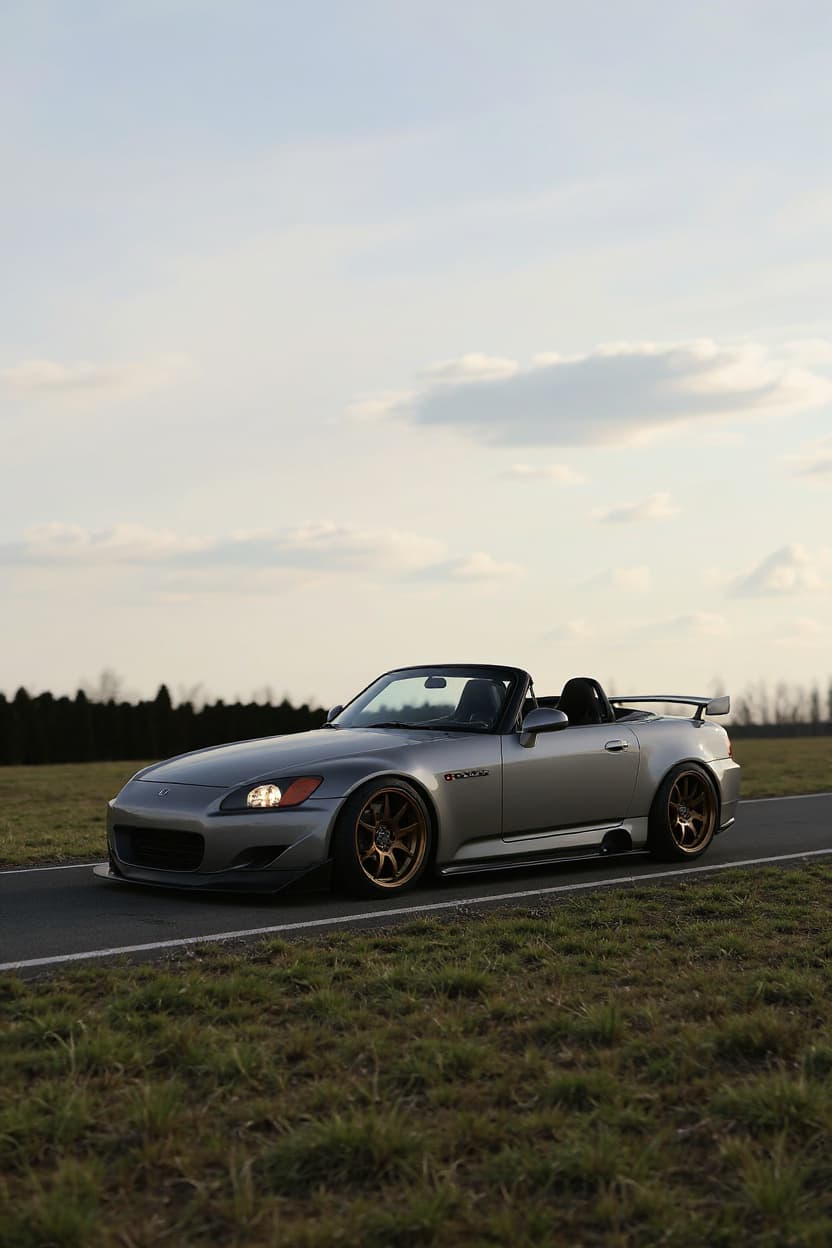
 AI render · JDM
Best JDM Cars: Every Platform Ranked by Culture, Buildability, and Value
The best JDM cars are defined by three things: cultural weight (how much the community cares about the platform), aftermarket depth (how far you can take the build), and value (what you get for the money). The JDM platforms below are ranked by all three. Building on the right platform produces something the community recognises and respects. Building on the wrong platform, or the right platform with the wrong approach, produces something it does not, regardless of the money spent.
Tier 1: The Definitive JDM Platforms
- Nissan Skyline GT-R (R32/R33/R34): the definitive JDM car. RB26DETT twin-turbo all-wheel drive. The R34 GT-R in Bayside Blue is the most recognized JDM car globally. Popularized by Gran Turismo and Fast & Furious. R32s are the most affordable entry point ($25,000–$45,000 for a clean USDM-eligible car), R34s are expensive ($80,000–$200,000+). The platform has a deep aftermarket and cultural weight that no other JDM car matches.
- Toyota Supra (A80): the 2JZ platform. The 1993–1998 A80 Supra with the 2JZ-GTE became the benchmark for JDM performance builds globally after Fast & Furious. A clean A80 costs $60,000–$120,000. The 2JZ engine alone carries cultural weight. Builds with 2JZ swaps in non-Supra chassis reference this.
- Honda NSX (NA1/NA2): Japan's answer to the Ferrari 328. Mid-engine, naturally aspirated, aluminum chassis. The NSX proved that reliability and supercar performance were compatible. Clean NA1s are $60,000–$120,000. The NSX carries cultural weight in the engineering community and among Honda platform enthusiasts.
- Mazda RX-7 (FD): the rotary-powered sports car. The FD3S's body styling is still considered one of the most beautiful of any Japanese car. The 13B-REW twin-turbo rotary produces 255hp from a 1.3L engine. Reliability concerns require an informed owner. Clean FDs are $25,000–$60,000.
- Honda Civic (EF/EG/EK): the affordable JDM platform. The EG hatchback (1992–1995) and EK hatchback (1996–2000) are the Kanjozoku-referenced platform, the JGTC-inspired time attack chassis, and the basis for countless K-swap builds. A clean EG or EK hatch can still be found for $5,000–$15,000.
Tier 2: Culturally Significant Platforms
- Nissan Silvia (S13/S14/S15): Japan's definitive sports coupe. The S15 was never sold in the US (legal imports starting in 2025 under the 25-year rule). The S13 and S14 are well-established platforms with deep aftermarket. The SR20DET swap is standard. S15s command a significant premium over S13/S14.
- Toyota AE86 (Corolla): the Initial D car. The AE86 Trueno and Levin hatchback are pure driving machines, lightweight, balanced, with the 4AGE engine that revs to 9,000 RPM. Clean AE86s are $15,000–$40,000. The car is culturally significant beyond its performance, Takumi Fujiwara's AE86 is an icon.
- Subaru Impreza WRX STI (GC8/GDB): the rally car. The STI platform from the 1990s carries WRC heritage, Subaru's World Rally Championship wins defined the car. Versions like the Version 6 and 7 with the EJ207 engine are the most respected. Values are climbing as clean examples disappear.
- Mitsubishi Lancer Evolution (IV–IX): the other rally car. The Evo IV through IX with the 4G63 engine are the performance benchmark, AWD, turbocharged, sophisticated AWD system. The 4G63 responds well to modification. Clean Evo IV–IX are $15,000–$35,000.
- Toyota Chaser / Mark II (JZX100): the sleeper. A luxury-appearing 4-door sedan with a 1JZ-GTE under the hood. Popular in Japan's street racing and drift culture. Only recently becoming available in the US under 25-year import rules. Cultural knowledge of the Chaser signals deep JDM awareness.
See your JDM build rendered before you commit to a platform. TunedRides renders any JDM style on your car. Free.
Try TunedRides free →
Tier 3: Modern JDM Platforms
- Toyota GR86 / Subaru BRZ (ZN8/ZD8): the modern AE86 spiritual successor. Naturally aspirated, rear-wheel drive, lightweight. The GR86 was received as a return to fundamentals. Deep aftermarket building rapidly. The correct platform for a modern touge-referenced build.
- Honda Civic Type R (FK8/FL5): the hottest hot hatch globally. Championship White is the correct color. The FK8 and FL5 carry Nürburgring records and real race pedigree. Proper base for a time-attack or track-day build.
- Toyota GR Corolla: the rally car for the road. The G16E-GTS engine is a genuine motorsport-derived three-cylinder turbo. The MORIZO Edition is a collector's item on arrival. JDM credibility is immediate.
- Subaru WRX (VB): the current WRX platform after Subaru discontinued the STI variant for North America. The FA24F engine is capable but the community is divided on the loss of the EJ platform. Still a strong rally-referenced base.
- Nissan Z (RZ34): the modern Z car. The VR30DDTT twin-turbo V6 has strong modification potential. Heritage design language references the S30. The aftermarket is building. This is a platform that will mature into a significant JDM build base.
What Makes a Platform the Right Choice
The right JDM platform for you depends on three factors: budget (a Skyline GT-R R34 costs 10x an EG Civic), intended use (show car vs. track car vs. daily), and how deeply you want to engage with the cultural context of the platform.
A beginner in JDM culture should start with an EG or EK Civic, cheap to buy, cheap to run, deep aftermarket, and culturally legitimate. An experienced builder who wants cultural respect should choose a platform they can build correctly, not the most expensive platform on the list.
See JDM render options for your specific car at the TunedRides JDM style hub.
Frequently Asked Questions
What is the best JDM car to buy?
For cultural significance and investment potential, the Nissan Skyline GT-R (any generation) is the definitive JDM car. For a build-ready platform at a reasonable cost, the Honda Civic EG/EK hatchback is the most accessible. For a daily driver with JDM credibility, the modern GR86 or Civic Type R are the current benchmarks.
What makes a car JDM?
JDM literally means Japan Domestic Market. A car built and sold specifically for the Japanese market. Culturally, it refers to cars associated with Japanese tuner culture: touge racing, VIP style, specific tuner houses (Veilside, RWB, Liberty Walk), and the visual codes of the Japanese modified car community.
Are JDM cars legal in the US?
JDM cars built 25 or more years ago are legal to import to the US under the 25-year exemption rule. This means R32 GT-Rs (built 1989–1994), S15 Silvias (built 1999–2002, only the earliest versions are currently eligible), and other classic JDM cars are now legally importable. Cars built after 1999 are still subject to import restrictions until they reach the 25-year threshold.
What JDM car is the most valuable?
The Nissan Skyline GT-R R34 in Bayside Blue is the most valuable JDM car for most buyers. Prices have reached $150,000–$200,000+ for clean examples. The Toyota Supra A80 TT and Honda NSX are also in the $80,000–$120,000 range for clean cars. The Mazda RX-7 FD is growing in value as clean examples become rare.
See what your JDM build looks like before you commit to a platform. Free render from your car photo.
Try it free — free →No credit card required. Free tier available.